

More Rules, Fewer Choices
Minimum Quality Regulations Take Cheaper Choices Off the Table

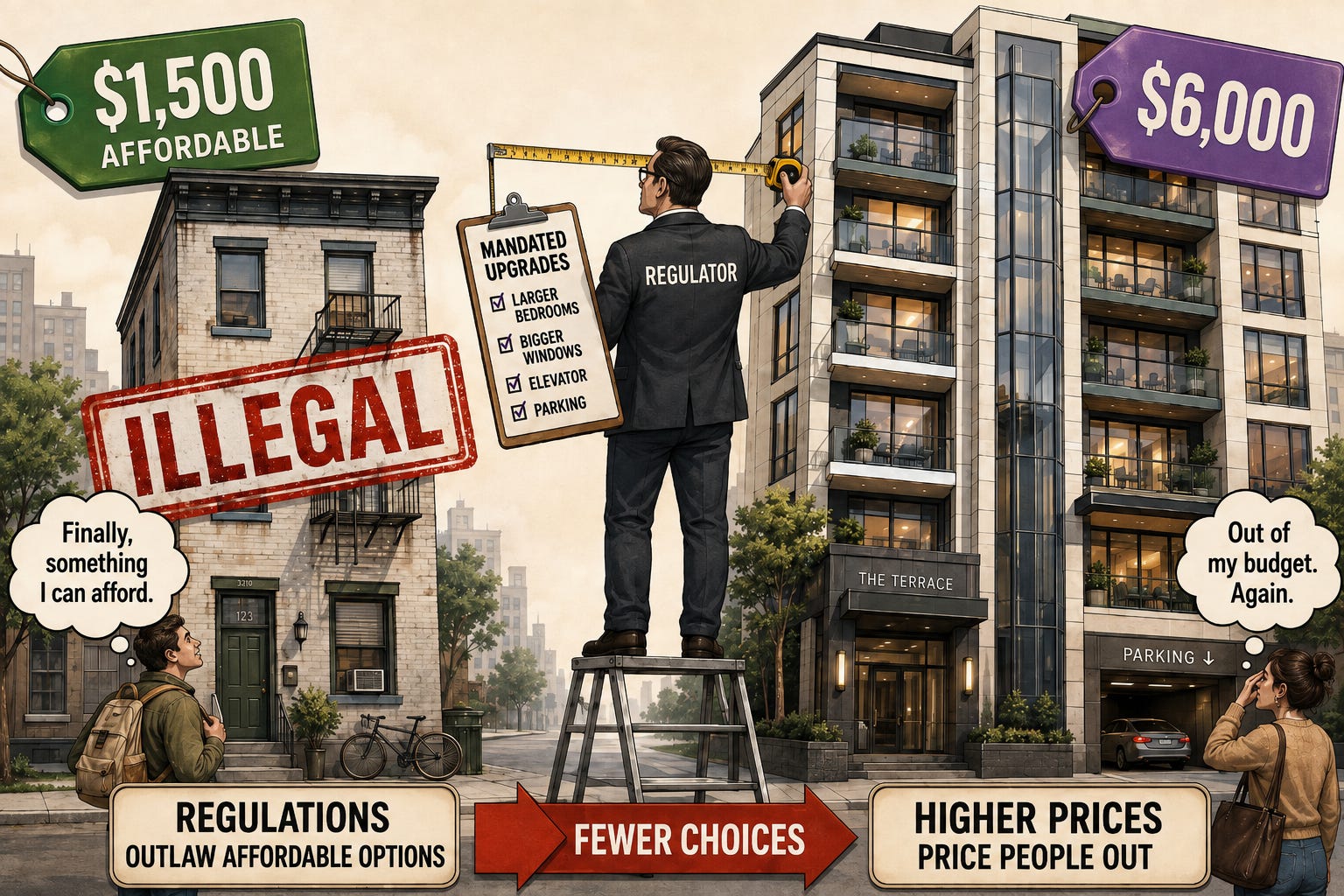
A larger bedroom is better than a smaller bedroom. A sunny room is better than a dark room. A spacious elevator is better than a cramped one. A building with parking is more convenient than one without it.
From those perfectly reasonable observations, regulators draw an unreasonable conclusion: every buyer must be required to purchase the “better” version.
The problem is that larger rooms, bigger windows, elevators, and parking spaces are not free. A regulation does just not give these features to consumers. It forces them to pay for these more expensive features by prohibiting cheaper products that do not have them.
Making Affordable Apartments Illegal
Consider New York City’s housing rules.
For many apartment buildings, the Housing Maintenance Code requires at least one living room of 150 square feet. Other rooms must be at least 80 square feet and have a minimum room width and ceiling height of 8 feet. The code also dictates that bedrooms must have windows and that each window must be a certain minimum size.
These may sound like modest requirements. But in a city where every square foot is extraordinarily expensive, even a few extra square feet can make the difference between an apartment that is affordable and one that is out of reach, between one that gets built and one that does not.
Suppose someone would gladly rent a seven-by-ten-foot bedroom in Manhattan. It would be small, certainly, but because it is cheap, it might allow that person to live alone without a roommate, remain close to work, or avoid a two-hour commute. Someone else might accept an interior sleeping room without a window in exchange for substantially lower rent. In many cases, these would be “starter apartments” or homes that would allow a person to save up money to buy a larger, better apartment or home later on.
However, the law takes away these choices. A person must live in an expensive, sunnier room, or none at all. The law can mandate larger, sunnier rooms but it cannot magically make them available at the lower, affordable price. It simply makes the cheaper rooms some people would have chosen illegal.
Because the cheaper alternative is outlawed, people must pay more, live with roommates, move farther away, or remain in the family home. Their housing has not been improved. Instead, their affordable option has disappeared. Their starter home or apartment remains a dream.
Unencumbered by such rules, the free market can and would offer a full range of quality options at various price points: large, sunny bedrooms for people willing to pay more for them and cheaper interior rooms to people who care more about price or location. Regulation permits only the first choice.
The Elevator That Never Gets Built
Elevators offer an even clearer example.
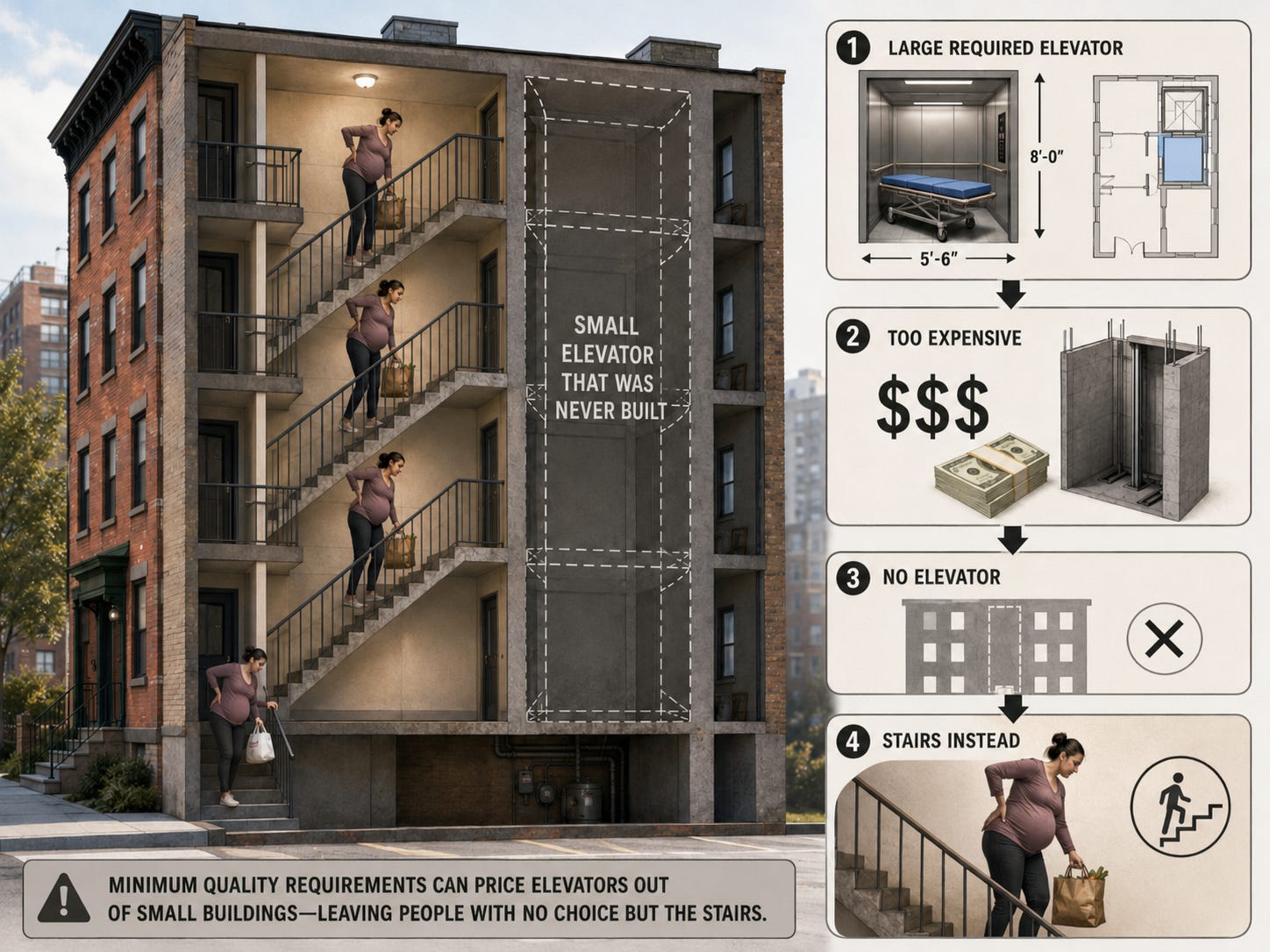
U.S. rules generally require much larger elevator cars than those permitted under European rules. New York, for example, requires certain buildings to have an elevator capable of holding a 24-by-84-inch ambulance stretcher horizontally. U.S. accessibility standards also commonly require enough room for a wheelchair to turn around. (New York City elevator requirements)
In much of Europe, a small apartment building may instead use an elevator measuring roughly 3.6 by 4.6 feet. That is large enough for a wheelchair user with another person standing behind, though not large enough for the wheelchair to turn around or for a full-sized stretcher to lie flat. (Center for Building in North America)
The American elevator is better – provided that it gets built.
But since it is twice as large, it is also much more expensive. A study by the Center for Building in North America found that elevators in the United States and Canada cost at least three times as much as comparable installations in Western Europe. Allowing European-sized elevators in American mid-rise buildings could reduce installation costs by an estimated 13 to 44 percent, even before counting the floor space saved by a smaller shaft. (Center for Building in North America)
So we do not end up with spacious elevators everywhere. We end up with far fewer elevators.
The United States and Canada have fewer elevators per person than any other high-income country examined in the study. The United States has more than twice as many multifamily homes as Spain but roughly the same number of elevators. Switzerland has about twice as many passenger elevators as New York City despite their similar populations. The United States has 40 percent fewer elevators per person than the Netherlands. (Center for Building in North America)
Americans therefore continue to build new four-, five-, and even six-story walk-up apartment buildings of a type now rarely being built in Western Europe.
The burden falls heavily on the very people accessibility rules were meant to help. Older residents, pregnant women, parents carrying children, injured people, and people with disabilities must climb several flights of stairs because the only elevator the law permits is too expensive to install. A good friend of mine, after returning home from the hospital following a Cesarean delivery, had to climb four flights of stairs because her building had no elevator. Such stories are common in New York City.
A small elevator would not be perfect. A wheelchair user might have to back out rather than turn around. Emergency personnel might need to tilt a stretcher or use a specialized chair.
But a small elevator is far more accessible than no elevator.
In the real world constrained by financial reality the choice is often not between a large elevator and a small one. It is between a small elevator and a staircase. Current regulations are mandating the staircase.
The Parking Space You Did Not Order
Parking requirements operate in much the same way.
Cities around the country impose mandatory parking requirements. Chicago’s zoning rules, for example, have imposed residential parking minimums ranging from 0.1 to two spaces per dwelling unit, depending on the type of development, although recent reforms have loosened some requirements near transit. (City of Chicago parking reform)
Imagine a developer who could build 50 modest apartments aimed at people who do not own cars. The likely tenants might include students, retirees, lower-income workers, and anyone who prefers public transportation.
A parking mandate does not give those residents free parking. It forces the developer to buy more land or construct an expensive garage and then pass the cost along through higher rents.
Some tenants must pay for parking they never use. Some apartments become more expensive. Others are never built because the garage makes the project financially unworkable.
The parking spaces are easy to see. The apartments sacrificed to produce them are not.
The Childcare Center That Never Opens
The same problem appears outside housing. Sadly, the harm is quite high where it was intended to help: childcare.
New York requires childcare centers to provide at least 35 square feet of classroom space for every preschool or school-aged child. (New York childcare regulations)
More space per child sounds appealing. But in Manhattan, Brooklyn, and other expensive markets, space is one of a childcare center’s largest expenses.
A 700-square-foot room may accommodate 20 children. The twenty-first child cannot be admitted, even when the parents, teachers, and operator all consider the room perfectly safe and adequate.
The rule does not magically make the classroom larger. Instead, it forces some parents to accept much worse alternatives: expensive babysitters they cannot afford or hidden, below-the-radar providers.
To meet these rules, a new daycare operator must raise tuition, find more expensive space, reduce enrollment, or abandon the project. Parents then face higher prices and fewer childcare options, all in the name of improving childcare.
The Unseen Missing Product
Regulators compare the legal product with the prohibited one and point out that the legal product is better.
Of course it is.
An apartment with large rooms, high ceilings, ample windows, a spacious elevator, and a parking garage is more luxurious than one with compact rooms, fewer windows, a small elevator, and no parking. Who doesn’t want to live in a mansion or drive a Cadillac?
But it is also more expensive.
What gets overlooked is the unseen missing product: the small bedroom that cannot legally be rented, the apartment eliminated by the larger elevator shaft, the modest building constructed as a walk-up because a code-compliant elevator costs too much, the apartment sacrificed for parking, or the affordable childcare center that never opened.
These products never show up in the statistics because the rules prevent them from being created.
Regulators can showcase to their constituents the large window, the spacious bedroom, and the capacious elevator they have mandated.
But the apartment that was never built – and the hidden suffering of those denied affordable choices – remains unseen.
The Economics of Voluntary Choice
Here is the basic economics.
Suppose buyers understand what they are purchasing and suppliers fully bear the cost of providing it. There is no fraud, hidden danger, or serious cost imposed on outsiders – in economic terms, no large externalities. In that case, the buyer and seller jointly bear the costs of their decision and jointly receive the benefits. The benefits and costs are fully internalized by both parties. This describes most markets for most products.
Sellers then have every reason to offer the combinations of price and quality that buyers want across the full range of price and quality levels.
Some people will pay more for large bedrooms, abundant windows, and parking. Others will trade space for location. Some will pay for a more luxurious building. Others will choose a basic apartment because they want to save money or because living alone matters more to them than amenities.
There is no single best apartment for everyone. Stated more generally, there is no single best product for everyone. Buyers and sellers should make those choices, not an outside third party.
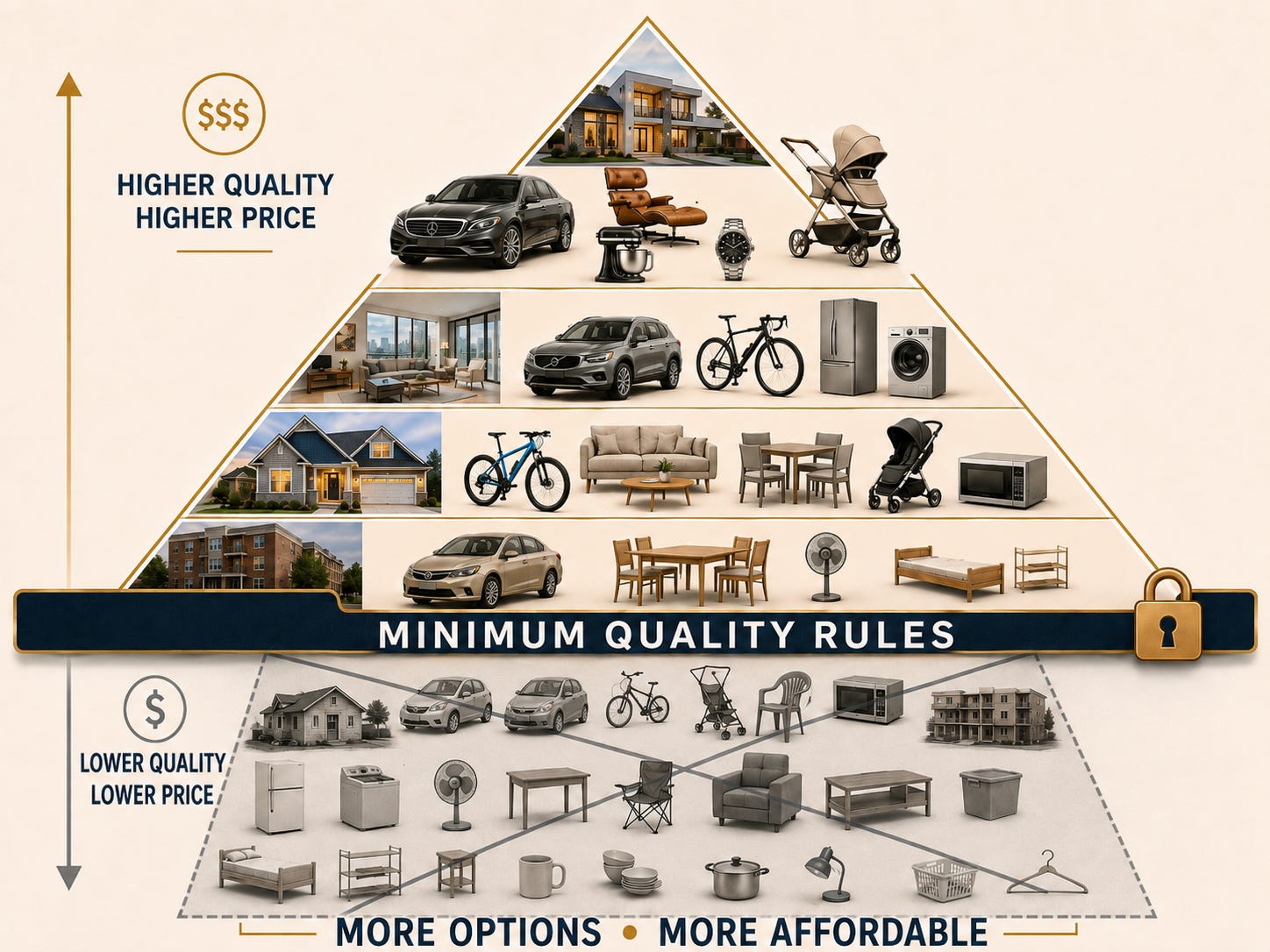
A binding quality rule does not increase the number of choices. It cannot increase the number of choices. Without the regulation, the higher-quality product would already be offered to anyone willing to pay for it. The rule does only one thing: it bans the lower-quality choice.
With minimum-quality regulation, some buyers will purchase exactly what they would have bought anyway. But others will be forced to pay for features they value less than their cost. Still others will be priced out entirely.
Safety Is a Different Concern, Already Covered by Existing Law
None of this means that sellers should be free to deceive buyers or expose them to hidden dangers.
A landlord who conceals a serious defect has committed fraud. A builder who knowingly uses unsafe materials or constructs a building so carelessly that people are injured may be liable for negligence—or, in extreme cases, criminal negligence. A property owner whose building harms neighbors can be held responsible for the damage.
But these are not really cases for “quality regulations” of the kind discussed here. They are applications of ordinary civil and criminal law: do not defraud people, do not recklessly endanger them, and pay for any harm you cause. Such rules already exist in common law, contract, tort, property, and criminal law. Such laws have been part of civilized jurisprudence for millennia.
A minimum bedroom size requirement is different. So is a rule requiring a particular amount of window space, parking, classroom area, or elevator capacity, and all minimum quality rules.
These rules do not punish fraud or negligence after someone has harmed another person. Instead, they forbid informed adults from mutually agreeing on a choice simply because a regulator – a third-party stranger – has arbitrarily decided that their choice is insufficiently spacious, comfortable, or convenient.
The law has a legitimate role in protecting people against deception, violence, and negligent harm. But such concerns should not become a pretext to dictate features of voluntarily purchased products.
Many people may prefer to pay for a larger bedroom, but that does not justify banning small ones. People enjoy sunlight, but that does not mean every room must contain a legally prescribed amount of glass. A large elevator may be more convenient, but that does not mean a small elevator is worse than no elevator at all.
When buyers and sellers bear the consequences of their decisions, minimum-quality rules do not protect choice. They take it away.